
Key takeaways
- Compare cabling bids by scope, testing, documentation, warranties, and exclusions, not bottom-line price alone.
- Define copper, fiber, pathways, racks, grounding, labeling, and certification requirements before requesting proposals.
- Use a detailed site survey to document routes, access limits, penetrations, existing conditions, and future capacity.
- Coordinate cabling with construction milestones and other trades to prevent costly conflicts after walls and ceilings close.
Structured Cabling Bids for Carson CA Projects: Copper Cabling and Network Construction
Structured cabling bids for Carson CA projects deserve more than a quick comparison of bottom-line pricing. A bid should show how a proposed network will be built, documented, tested, and handed over for long-term use. For offices, warehouses, schools, municipal facilities, retail sites, and new developments across Carson, the cabling scope often links directly to the construction schedule: walls close, ceilings go in, and access becomes limited. Clear bid documents help general contractors coordinate the cabling contractor with electrical, security, AV, fire alarm, and drywall trades before those conflicts become costly field changes. A sound proposal identifies the copper cabling category, outlet counts, pathways, racks, patch panels, grounding, labeling, certification testing, and warranty coverage. It should distinguish the permanent network cabling installation from active equipment such as switches, wireless access points, and cameras. Where a site needs fiber optic backbone links between telecom rooms, buildings, or remote equipment areas, the bid should state fiber type, strand count, termination method, enclosure hardware, testing standards, and whether splicing is included.

Structured Cabling Bid Comparison Checklist
| Bid Item | What the Proposal Should Define | Why It Matters for Comparison |
| Copper cabling scope | Cabling category, outlet counts, permanent cabling installation, patch panels, racks, grounding, and labeling. | Shows whether each bid covers the same network infrastructure. |
| Active equipment | Whether switches, wireless access points, cameras, or other active devices are included or excluded. | Separates passive cabling work from equipment costs. |
| Fiber backbone links | Fiber type, strand count, termination method, enclosure hardware, testing standards, and splicing scope. | Prevents gaps between proposals for telecom rooms, buildings, or remote equipment areas. |
| Pathways and site infrastructure | Pathway scope and responsibility for racks, telecom-room power, core drilling, lifts, and firestopping. | Identifies infrastructure items that may otherwise become added field costs. |
| Testing and certification | Certification testing requirements and applicable testing standards. | Confirms that installed cabling will be tested against the stated requirements. |
| Documentation and closeout | Network documentation and closeout records included with the work. | Shows what records the owner will receive after installation. |
| Warranty coverage | Warranty coverage for the proposed cabling installation. | Allows teams to compare post-installation coverage. |
| Schedule coordination | Labor assumptions and a schedule tied to site milestones, such as wall closure and ceiling installation. | Helps coordinate work before site access becomes limited. |
| Trade coordination | Coordination with electrical, security, AV, fire alarm, drywall trades, and the owner’s IT team. | Reduces conflicts that can lead to field changes. |
| Permits, access, and safety | Responsibility for permits, after-hours access, safety planning, and prevailing wage obligations where applicable. | Clarifies project requirements that affect labor, timing, and cost. |
| Demolition and existing conditions | Whether demolition, cable removal, and remediation of existing pathways are included. | Reveals scope differences that may not appear in bottom-line pricing. |
| Public-project requirements | Bid forms, bonding information, and proof that specified products meet the governing standard. | Supports review of formal procurement requirements for public work. |
Bid scope checklist
- State copper category, outlet counts, pathways, racks, patch panels, grounding, and labeling.
- Separate permanent cabling from switches, access points, cameras, and other active equipment.
- List fiber type, strand count, terminations, splicing, enclosures, and testing standards.
- Assign responsibility for permits, lifts, drilling, firestopping, power, and after-hours access.
- Require certification results, as-built records, warranty details, and documented exclusions.




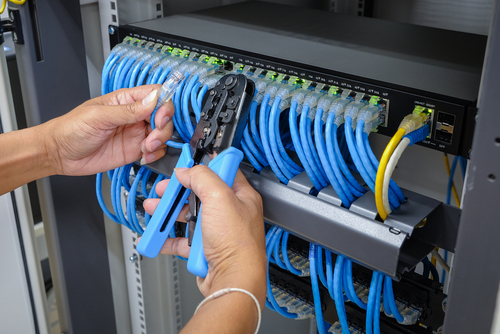




Site Survey for Commercial Network Installation and Bid Readiness
A detailed site survey turns a commercial network installation from an assumption into a buildable plan. Before purchasing equipment or requesting bids, the field review documents the conditions that shape cost, labor, materials, access, and scheduling. For Carson businesses, that means looking beyond a floor plan to the realities of the property: occupied offices, warehouse racking, ceiling type, tenant operations, electrical pathways, security rules, and the routes available between telecom rooms.
The survey should trace each proposed network run from the main equipment room to work areas, wireless access point locations, cameras, phones, and specialty devices. That field record identifies pathways for copper cabling, points where new conduit or cable tray may be needed, fire-rated wall penetrations, and areas where lifts or after-hours work may be required. Existing cable conditions matter too. A bundle of unidentified lines above a ceiling may affect removal work, pathway capacity, and the timing of a structured cabling installation.
Fiber optic planning deserves the same close attention. A project may call for backbone fiber between floors, buildings, IDF rooms, or exterior enclosures. The survey records conduit size, pull distances, bends, handholes, entrance points, grounding conditions, and separation from power. Those details help determine fiber count, jacket type, termination hardware, and whether the route can support future growth without reopening finished construction.
Clear survey notes give purchasing teams a reliable basis for ordering cable, racks, patch panels, pathways, enclosures, and specialty hardware. They give general contractors a coordinated scope that fits the construction schedule rather than creating late field conflicts. They give installers enough information to price labor honestly, including access restrictions and restoration work. Most of all, they make bids easier to compare: each bidder can price the same documented network scope, rather than filling gaps with allowances or exclusions. A well-prepared survey leaves the project team with drawings, photos, route notes, counts, room details, and a defined installation scope ready for review.
Site Survey Checklist
- Map cable routes from equipment rooms to every device location.
- Record ceiling types, pathways, penetrations, access limits, and after-hours requirements.
- Inspect existing cables, trays, conduit capacity, and unidentified line bundles.
- Document fiber distances, bends, handholes, entrance points, grounding, and power separation.
- Capture drawings, photos, counts, room details, and restoration needs for bid pricing.